
AM vs FM Radio: What Is the Difference?
October 04, 2026 · Updated November 02, 2026
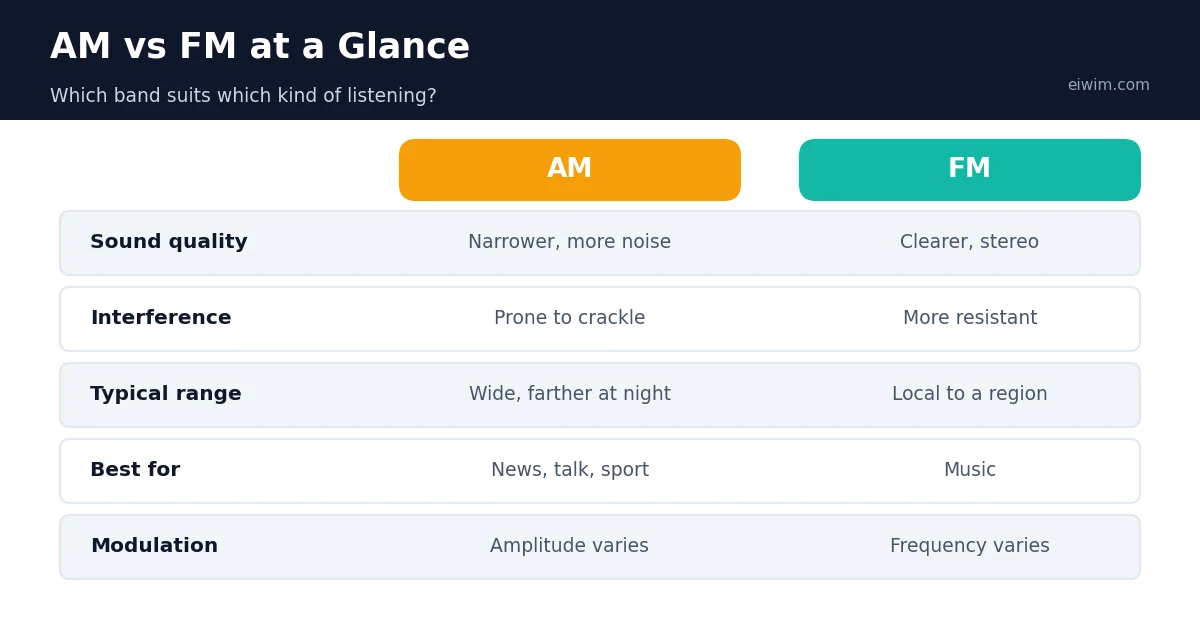
If you have ever scanned a car radio, you have seen the AM and FM bands. Both carry audio on radio waves, but they do it in different ways, which affects how they sound and how far they reach.
What AM and FM stand for
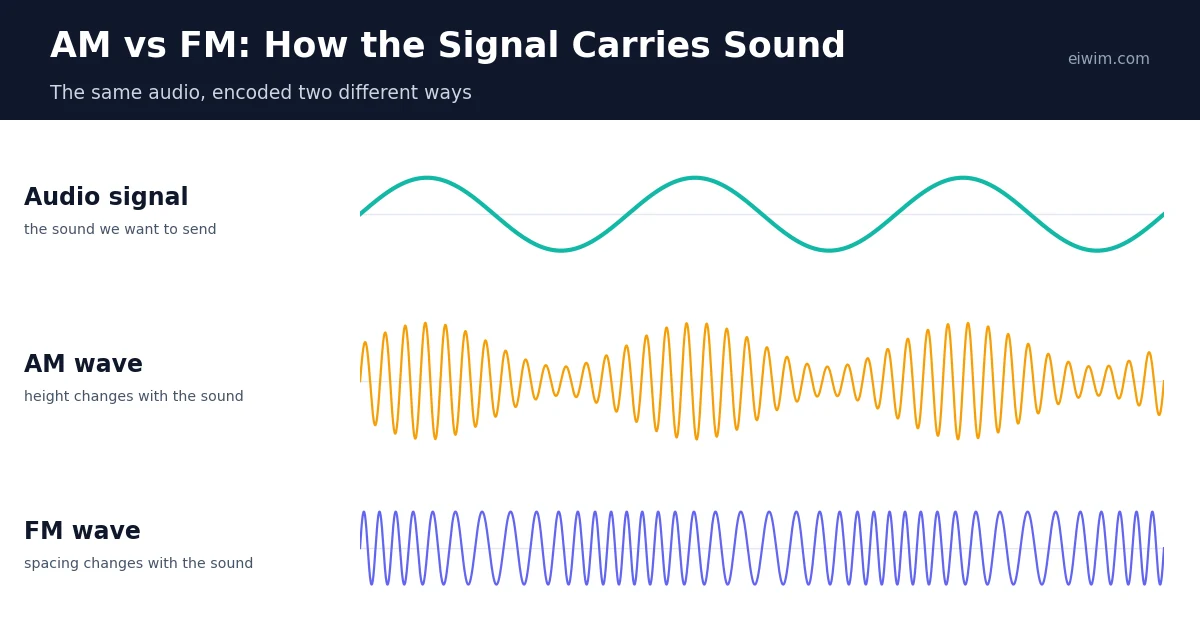
AM means amplitude modulation: the strength of the radio wave is varied to carry the sound. FM means frequency modulation: the frequency of the wave is varied instead. Because FM is less affected by electrical interference, it generally sounds cleaner.
Frequency ranges
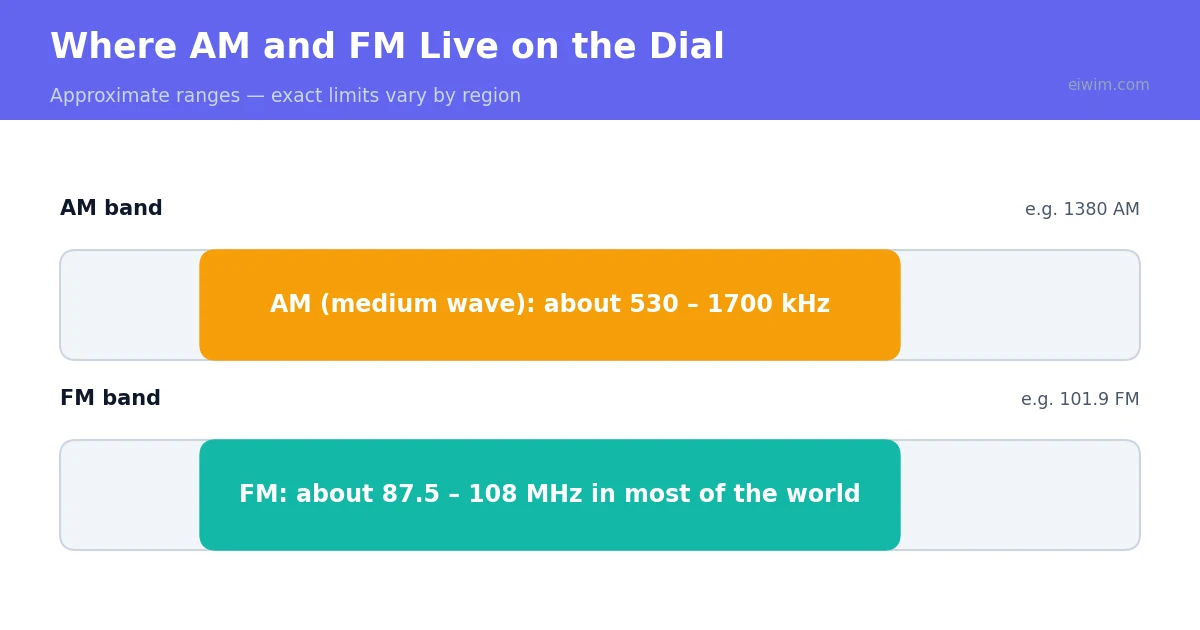
The exact ranges differ by region, but as a guide the AM (medium wave) band runs from roughly 530 to 1700 kHz, while most of the world uses about 87.5 to 108 MHz for FM. That is why FM stations are written as numbers such as 101.9 and AM stations as numbers such as 1380.
Sound quality
FM usually offers better sound, including stereo, and is the standard for music. AM has a narrower audio bandwidth and is more prone to crackle from power lines and electrical equipment, so it suits speech better than music.
Range and coverage
FM signals mostly travel in a straight line, so coverage is typically limited to a city or region. AM signals can follow the curve of the earth more, and at night they can travel much farther, so a distant AM station may sometimes be heard far from its home.
What you usually hear on each
- FM: music stations across most genres, including Pop, Rock and Country.
- AM: news, talk, sport and call-in programmes, which you can also find in the News-Talk category.
Where internet radio fits in
Many AM and FM stations also stream online. That means you can hear a station from another country without needing a radio in its coverage area. On Eiwim, the frequency in a station's name (for example 101.9 or 1380 AM) tells you how it is known on the dial, while the player above lets you listen from anywhere.
Want to explore? Browse stations by country to see which broadcasters are available near and far.
How a receiver tells AM and FM apart
An AM receiver and an FM receiver both begin by selecting one station from the many that fill the air. A tuner picks the frequency you choose and ignores the others. The next stage is called demodulation, which means extracting the original sound from the radio wave. In AM, the receiver follows the changing height of the wave, and in FM it follows the changing frequency. AM receivers can be extremely simple, which is why early crystal radios could work without batteries. FM receivers need slightly more complex circuits, but they reject noise better, which is why the sound is cleaner.
Other bands: shortwave and longwave
AM and FM are not the only broadcast bands. Shortwave covers roughly 3 to 30 MHz and can travel very long distances because signals bounce off a layer of the upper atmosphere called the ionosphere. For many years shortwave was used by international broadcasters to reach listeners in other countries, and some still use it. Longwave, used mainly in parts of Europe and Asia, lies at much lower frequencies and can cover large areas with a single transmitter. These bands matter less to everyday listeners than they once did, but they are still part of the radio story, and many online stations began as international shortwave services.
Stereo, RDS and other FM features
FM offers features that AM usually lacks. Stereo sound is standard on FM music stations, with a clean separation of left and right channels. Many FM stations also transmit RDS data, which lets a receiver display the station name, show song titles and follow a station to a better frequency as you travel. Some receivers use RDS to interrupt other audio for traffic announcements. These features are one reason FM became the main band for music. You can see how the same ideas carry over to digital broadcasting in our guide to DAB, DAB+ and HD Radio.
Why AM and FM are still around
Online streaming has not replaced AM and FM, partly because they are cheap, reliable and independent of the internet. A single transmitter can reach very large numbers of people without extra cost for each listener, and a battery-powered radio works during emergencies when networks fail. Rural areas often depend on AM and FM because mobile coverage is weak. At the same time, some countries are moving away from analogue broadcasting. Norway, for example, switched off national FM broadcasting in 2017 in favour of digital radio. Elsewhere, both analogue and digital services will probably continue side by side for many years.
Tips for better reception
- Extend the antenna fully and try different angles, since FM signals are polarised and sometimes respond to orientation.
- Move the radio closer to a window or away from computers, chargers and other electronics, which can create interference.
- For AM, rotate the radio itself, because many portable AM sets have a built-in ferrite antenna that works best in one direction.
- If a station is hard to receive, check whether it also streams online. Browse the genres page to find similar stations that come through clearly.
Which band suits which listener?
Your choice depends on what you want from the radio. If you care about sound quality and want music in stereo, FM is the better option in almost every case. If you want news, talk or sport from a station that covers a very large region, or if you travel through rural areas, AM may reach places that FM cannot. If you enjoy distant listening as a hobby, AM at night and shortwave at any hour offer an unusual thrill, because stations hundreds or thousands of kilometres away become audible. And if you want the widest choice with the least fuss, an internet stream gives you stations from both bands and from many countries at once. Our guide to internet radio compared with FM, podcasts and music apps covers that comparison.