Internet Radio vs FM vs Podcasts vs Music Apps: What Is the Difference?
November 02, 2026
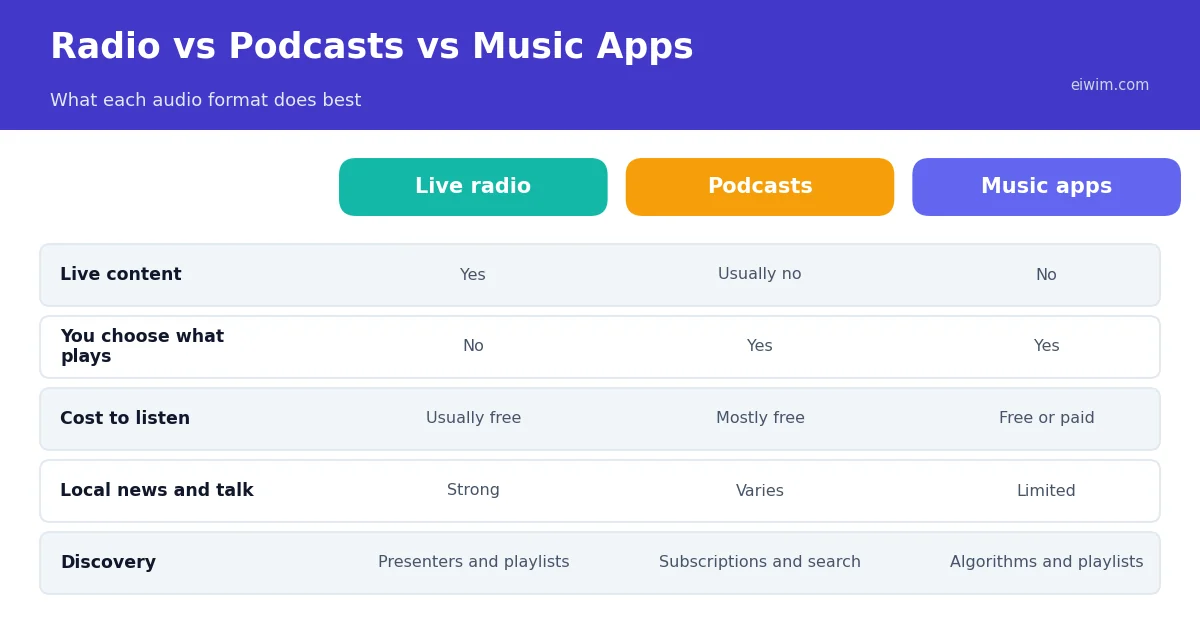
Radio, podcasts and music apps all deliver audio to your phone, but they work in different ways and suit different moments. Knowing the differences makes it easier to choose.
Live radio
A radio station sends one live programme to everyone at the same time. You cannot choose the next song, but that is part of the appeal: presenters react to the news, play requests and talk about what is happening right now. Radio is also where you find local weather, traffic and community announcements. Many stations are available both over the air and as an internet stream.
Podcasts
A podcast is a recorded series you download or stream whenever you like. Episodes can run from five minutes to several hours and cover almost any subject. You choose the show and the moment. The trade-off is that nothing is live, so podcasts are less suited to news that changes by the hour.
Music apps
Music streaming services let you search for any track in their catalogue and build playlists. They are excellent when you know exactly what you want to hear. Their strength, control, is also their limit: without effort you tend to hear what you already like.
Where internet radio sits
Internet radio combines parts of each. Like radio, it is live and programmed by people. Like a streaming service, you can reach it from any device and choose from stations around the world. That makes it a good tool for discovery: browse by genres page, try a new country from the countries page, or pick a language you want to practise.
Practical differences
- Data: all three use data when streamed, but you can lower it by choosing a lower-bitrate station. See our bitrate guide.
- Offline use: podcasts and music apps usually allow downloads; live radio does not, unless you have an over-the-air receiver.
- Cost: radio streams are free. Podcasts are mostly free. Music services often have free and paid tiers.
Using them together
Many listeners mix formats: live news and talk radio in the morning, a podcast on the commute, a favourite playlist in the evening. If you want to find something new, try a station you would not normally choose. Our post on discovering new music through online radio has practical ideas.
Cost compared
Cost is often the deciding factor. Listening to radio is free, whether you tune in over the air or through an online stream. Podcasts are mostly free as well, although some creators offer paid extras or ad-free versions. Music apps usually have a free tier supported by advertising, with restrictions such as limited skipping, and a paid tier that removes ads and offers more control. If your budget is tight, radio and podcasts give you hours of listening without a subscription. If you want to choose every song, a music app is worth considering, and you can still use radio to discover new artists.
Control versus discovery
The big difference between these options is who decides what you hear. With a music app or a podcast, you decide. You choose the song or episode and the order, and you can repeat or skip at will. With radio, a presenter or programmer decides, and you receive a stream of surprises. Some people love control, while others find endless choice tiring and prefer to let someone else pick. Radio is especially good at exposing you to music and voices you would never have searched for. It also supplies a sense of shared time, because other listeners are hearing the same programme at the same moment.
Data and offline use
Streaming live radio needs a continuous connection, and you cannot download it in advance. At 128 kbps it uses about 57.6 MB per hour. Podcasts and many music apps allow downloads, so you can fill your device while on Wi-Fi and listen offline later, which saves mobile data and works on planes and in places with weak signal. If you commute through areas with poor coverage, a downloaded podcast may be more reliable than a live stream. If you often listen at home on Wi-Fi, live radio is simple and requires no preparation.
Which to pick for which moment
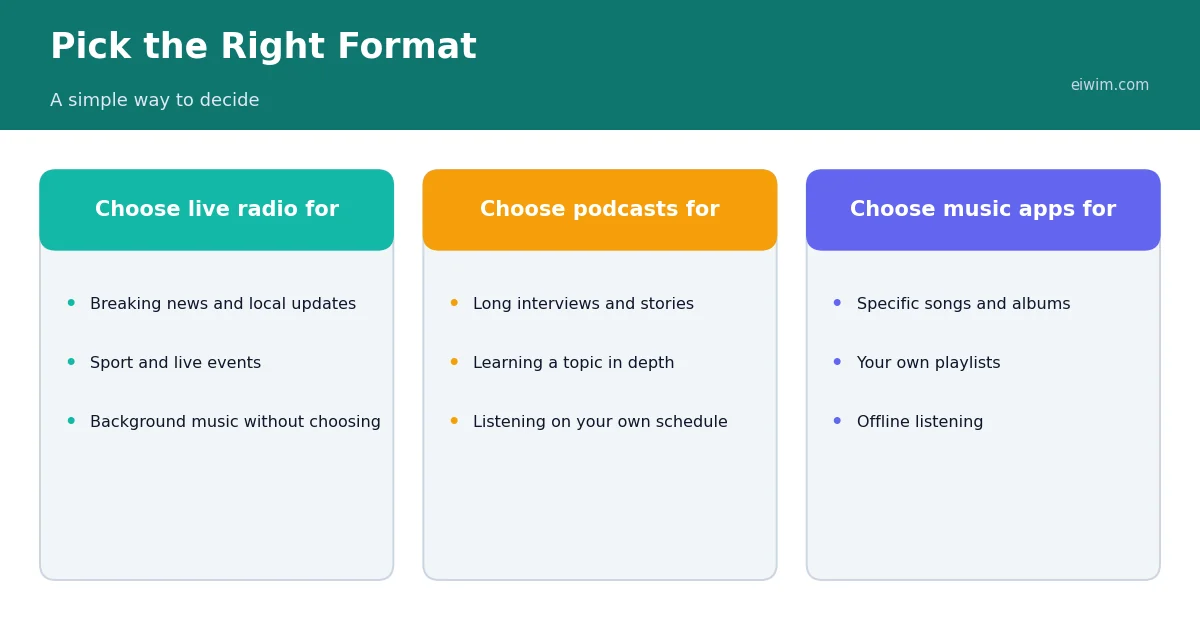
- Waking up or making breakfast: live radio with news, weather and traffic.
- Commuting with a good signal: radio or a music app.
- Commuting underground or abroad: downloaded podcasts or music.
- Learning something: a podcast on a single topic, or talk radio.
- Exploring new music: radio, especially specialist shows. See our guide to discovering new music through online radio.
- Background noise at work: a long-running radio stream or playlist. See radio genres for studying and focus.
Privacy and personalisation
Music apps and some podcast platforms build detailed profiles of what you play, so they can make recommendations and show targeted ads. This is useful for some listeners and uncomfortable for others. A radio stream collects much less, usually only technical information such as your connection and approximate location. If you value privacy, live radio is a simple option. Read each service's privacy policy to understand what it does with your data, and see our tips for staying safe while streaming.
Using them together
You do not need to pick one forever. A common pattern is to use radio for the morning and for discovery, podcasts for longer journeys and learning, and a music app for your own playlists. Whatever you choose, remember that radio remains the only option that is live, local and free of any decisions. For a detailed look at how it compares with a more traditional receiver, read AM vs FM.
A quick decision guide
If you only remember one thing, remember this: choose radio when you want to be surprised, podcasts when you want to learn or follow a story, and music apps when you want exactly the songs you named. Most people end up with a mix. Start with a few radio stations in genres you like, add one or two podcasts that match your interests, and keep a small playlist for the moments when only one song will do. Revisit the mix every few months, and you will find that your listening stays fresh without extra effort.
Quick answers
Does internet radio use a lot of data?
A 128 kbps stream uses about 57.6 MB per hour. Lower-bitrate stations use less.
Can I listen to radio offline?
Live internet radio needs a connection. An FM or DAB receiver works without data, and podcasts can often be downloaded.
Which format is best for news?
Live radio is usually best for breaking news, while podcasts suit longer explanations.