DAB, DAB+ and HD Radio Explained: Digital Radio Without the Internet
October 30, 2026 · Updated November 01, 2026
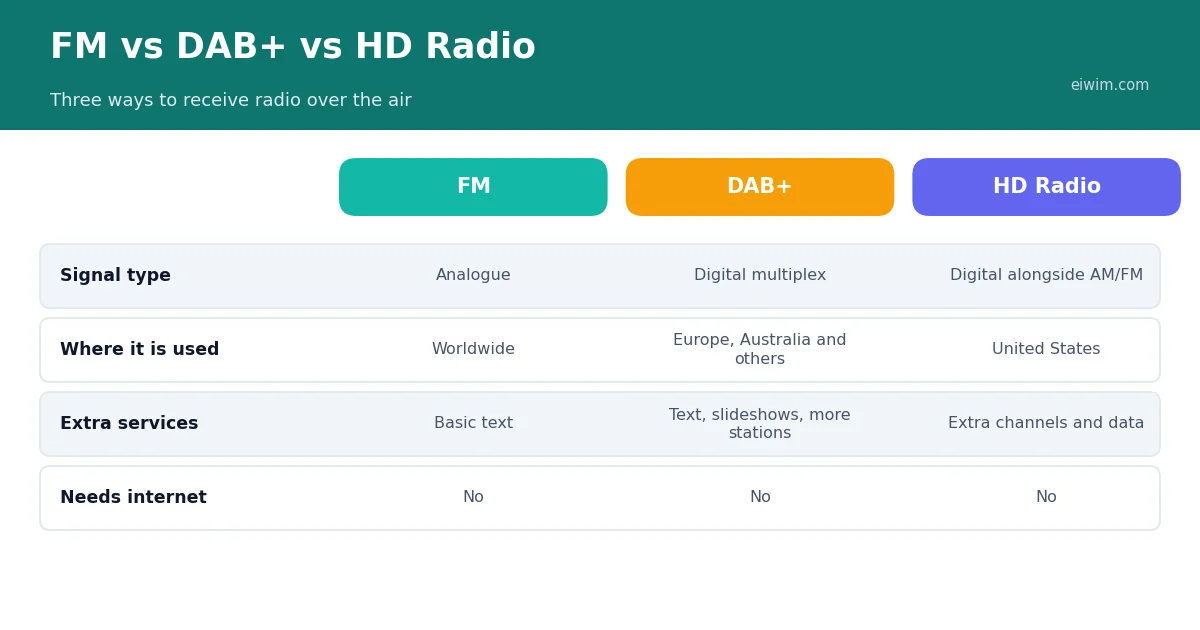
Not all digital radio comes through the internet. Many countries also broadcast radio digitally over the air, and the receiver in a car or on a kitchen shelf does not need a data connection at all. Here is how the main systems compare.
DAB and DAB+
Digital Audio Broadcasting (DAB) was developed in Europe and began service in the mid-1990s; the BBC launched its first DAB service in 1995. Its successor, DAB+, uses a more efficient audio codec, which lets more stations fit into the same amount of spectrum. Several European countries and Australia use DAB+, and Germany has expanded its national DAB+ offering since 2011. A DAB or DAB+ receiver shows the station name and often scrolling text about the current programme.
HD Radio
In the United States, the approach is different. HD Radio sends a digital signal alongside, or in the same channel as, existing AM and FM stations. The regulator approved this in-band, on-channel method in 2002. A listener with an ordinary receiver still hears the analogue broadcast, while an HD receiver can switch to the digital one and sometimes find extra sub-channels.
Why digital radio?
- More choice: a single multiplex can carry many stations.
- Cleaner sound: digital signals avoid the hiss that affects weak analogue stations.
- Easier tuning: you pick a station by name instead of a frequency.
- No data plan: unlike streaming, reception does not use mobile data.
Where internet radio fits
Digital terrestrial radio covers a limited area and depends on local transmitters. Internet radio has no such limit: any station that streams can reach any listener with a connection. That is why directories like Eiwim exist. You can listen to a German public broadcaster, a Canadian talk station and a Brazilian music channel in the same hour. For the differences between formats, see internet radio versus FM, podcasts and music apps.
Which should you use?
If you travel by car and want reliable coverage without using data, a DAB+ or FM receiver is hard to beat. If you want variety from many countries, streaming is the better choice. Many people use both. For the history behind these formats, read our short history of radio.
How a multiplex works
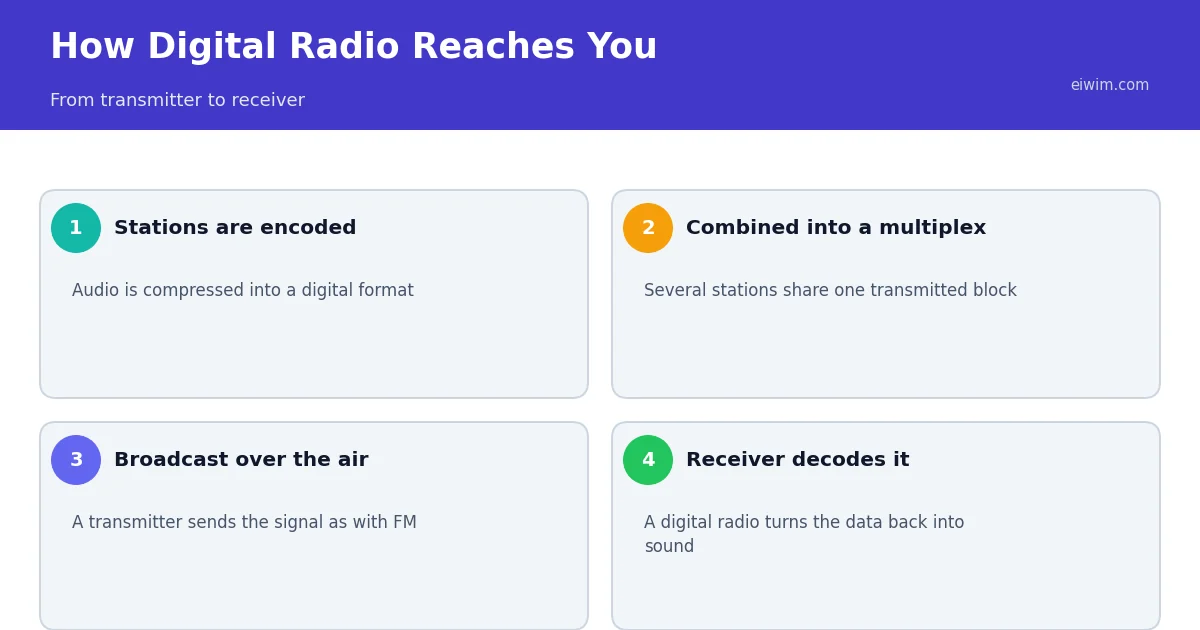
The key idea behind DAB is the multiplex. Instead of one transmitter carrying one station, a single transmitter carries a bundle of stations in one block of spectrum. The block is called an ensemble or multiplex. Because digital signals can be compressed and combined, a multiplex can carry many stations at once, along with text and data. For broadcasters, this means more channels at a lower cost per station. For listeners, it means a larger choice of stations on one frequency block. When you scan for stations on a DAB radio, the receiver finds the multiplexes in your area and lists the stations in each.
DAB and DAB+: what is the difference?
The original DAB system used an audio compression format called MP2. DAB+ is an updated version that uses a more efficient format, AAC, which gives better sound at lower bitrates. This allows many more stations to fit into one multiplex. DAB+ radios are generally backwards compatible with DAB, but older DAB-only radios cannot play DAB+ stations. If you are buying a new radio, look for the DAB+ label so you can receive both. Many countries have moved or are moving towards DAB+.
Extra information on screen
One benefit of digital radio is the extra information that appears on the display. Most stations send the station name, the song title and artist, and sometimes news headlines or traffic information. Some also send images, such as album covers or logos. This is similar to the text that FM can show using RDS, but digital systems can carry more. You can see how the older FM features work in our guide to AM vs FM radio.
HD Radio in more detail
HD Radio, used mainly in the United States, adds a digital signal alongside the existing analogue AM or FM signal. In hybrid mode, the station broadcasts both, so listeners with ordinary radios hear the analogue signal, and listeners with HD receivers hear the digital one. FM HD Radio can also carry extra channels, often called HD2 and HD3, that play different programming from the main station. Because the digital signal sits next to the analogue one, no new frequency band is needed, which is a key difference from DAB.
Digital radio in the car and at home
Many new cars include digital radio as standard in countries where it is common, and adapters can add it to older cars. At home, digital radios are widely available at moderate prices. Reception depends on coverage, which may be better or worse than FM depending on where you are. In areas with weak digital signals, sound may cut out instead of fading slowly, which some listeners find more annoying than FM hiss. If this happens, switching to the station's internet stream can be a good backup. You can read more in our post on listening to radio in the car.
Is digital radio worth it?
For many listeners, the main benefit of digital radio is convenience: stations are listed by name, not frequency, there is no hiss and extra stations are available. The drawbacks are the need for a compatible receiver, uneven coverage and the fact that sound can drop out when the signal is weak. If you already own an internet-capable device, you can enjoy a similar range of stations through streaming. If you want a dedicated radio that works without a connection, digital radio is a good choice in countries where it is well established. In countries where FM remains dominant, an FM radio is still the simplest option.
Quick answers
Is DAB radio the same as internet radio?
No. DAB is broadcast over the air from transmitters, so it needs no internet connection or data plan.
Can a DAB radio receive DAB+?
Not always. Older DAB-only receivers cannot decode DAB+, so check the label before buying.
Is HD Radio available outside the United States?
It is mainly a US system. Most other countries use DAB or DAB+ for digital radio.