Electronic Music Genres Explained: House, Techno, Trance and Drum and Bass
October 12, 2026 · Updated November 01, 2026
"Electronic music" covers an enormous range of sounds made mainly with synthesizers, drum machines and computers. The names can be confusing, but a few key distinctions make it easy to navigate on the radio dial.
House
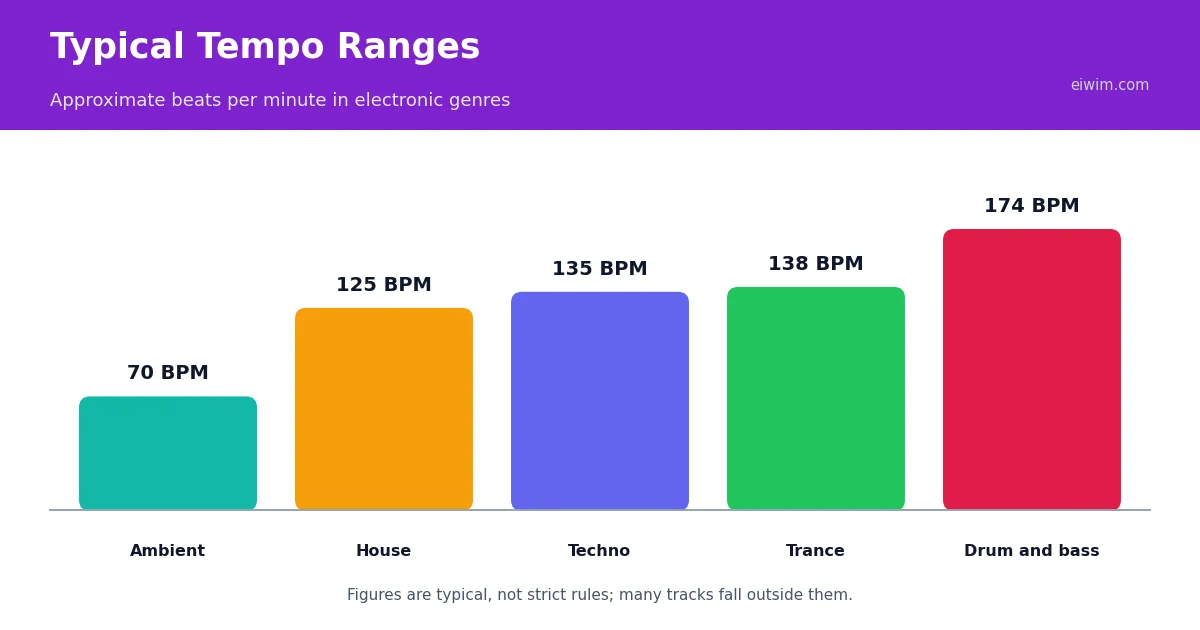
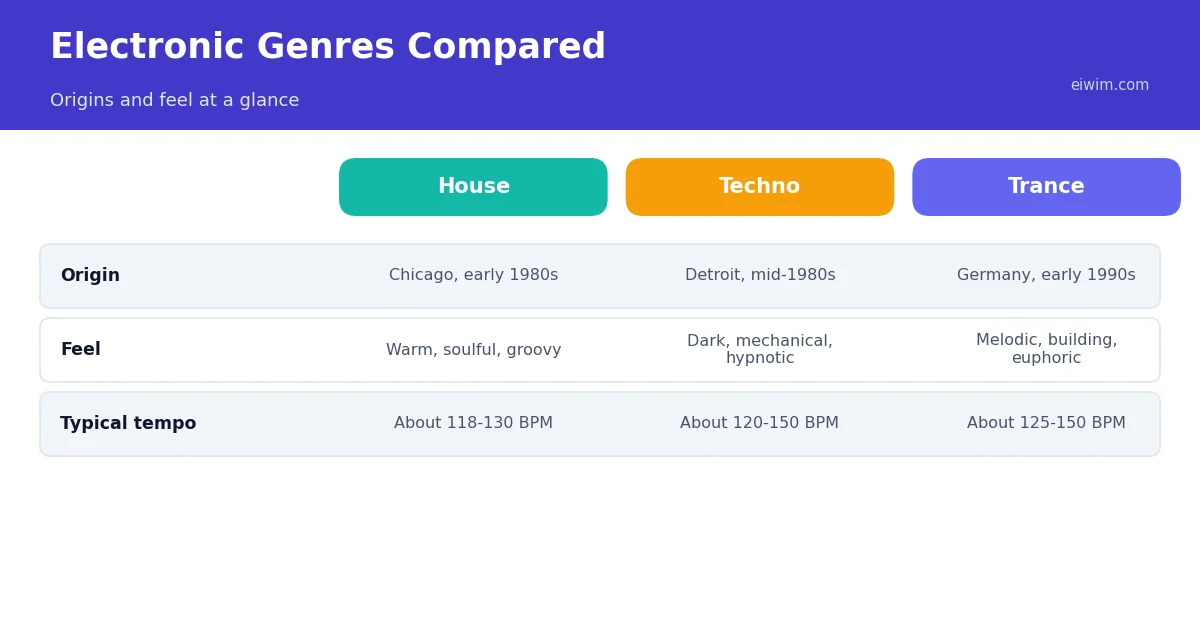
House music emerged in Chicago clubs in the early 1980s. It is built on a steady four-on-the-floor kick drum, with a tempo of roughly 118 to 130 beats per minute, and often features soulful vocals, piano chords and bright synth lines. It is warm and danceable. Try the House stations, and also look at Progressive House for a more gradually building style.
Techno
Techno developed in Detroit in the mid-1980s, shaped by producers such as Juan Atkins, Derrick May and Kevin Saunderson. It is more mechanical and repetitive than house, usually between 120 and 150 BPM, and focuses on rhythm, texture and gradual change rather than songs. Browse Techno and the related Minimal stations.
Trance
Trance became popular in Germany and across Europe in the early 1990s. It uses long, melodic builds, arpeggiated synth lines and dramatic breakdowns, typically at 125 to 150 BPM. The aim is an uplifting, almost hypnotic effect. Explore Trance.
Drum and bass
Drum and bass grew out of jungle in the UK in the early to mid-1990s. At about 160 to 180 BPM it is far faster than house, with rapid breakbeats and deep sub-bass. Find it under Drum'n'Bass.
Ambient and chillout
At the other end of the spectrum, ambient music is slow, textural and often beatless. Brian Eno's 1978 album Ambient 1: Music for Airports helped name the style. Chillout and downtempo stations sit between ambient and dance, with relaxed beats. See Ambient, Chillout and Electronica.
Disco and eurodance
Dance music did not begin with synthesizers. Disco in the 1970s laid the groundwork for house, and eurodance brought upbeat European dance-pop to the charts in the 1990s. Stations tagged Disco and Eurodance show those roots.
How to choose a station
- For energy while exercising or cleaning, try house, techno or trance.
- For background while working, choose ambient, chillout or minimal. See our focus and study guide.
- For general electronic variety, the broad Electro category mixes styles.
Tempo is only a guide
Genres overlap, and producers often cross boundaries, so treat the numbers above as typical ranges. The best approach is to listen for ten minutes and notice whether the beat, mood and melody match what you want. For more ways to explore styles, see how to discover new music through online radio.
How electronic music is made
Electronic music relies on machines rather than traditional instruments. A synthesizer creates sounds by generating electrical waves that can be shaped into bass, leads, pads and effects. A drum machine plays programmed rhythms, and a sampler records and replays pieces of other sounds. Today most producers work on a computer using software known as a digital audio workstation, which combines all these tools and allows an entire track to be built on a laptop. This accessibility is one reason electronic music has grown so quickly. A single producer can create a polished track in a bedroom, and radio stations often play new releases from independent artists.
DJ culture and radio mixes
Much electronic music is designed to be mixed by a DJ. A DJ plays two or more tracks at the same time, matching their tempo so the beats line up, a technique called beatmatching, and then fading from one to the other so the music never stops. The result is a continuous set that can run for hours. Radio shows often broadcast DJ mixes, which is why electronic stations tend to sound seamless, with fewer talking breaks than other formats. If you like long, flowing sets, look for shows that describe themselves as mixes or live sets.
Styles beyond the main four
House, techno, trance and drum and bass are only part of the picture. Garage and its offshoots developed in the UK from house music, with skippy, syncopated rhythms. Dubstep emerged in London in the early 2000s, built on slow tempos, heavy sub-bass and wobbling basslines. Electro and electronica cover a wide area, from old-school machine funk to experimental and atmospheric music. You can explore these on Electro and Electronica stations, and the slower, more relaxed side of the spectrum on Chillout and Ambient. If you enjoy the calm end, our guide to relaxing radio for sleep and winding down has suggestions.
Listening tips
- Use headphones or decent speakers. Bass and fine details are a big part of electronic music, and small phone speakers lose both.
- Choose a stream with a higher bitrate when you can, because heavy compression can blur the sharp details of electronic sounds.
- Keep the volume sensible. Bass-heavy music feels loud even at moderate levels.
- Try stations from other countries. Berlin, Detroit, Chicago, London and many other cities have distinct scenes, and you can browse by country to hear them.
Electronic music and everyday life
Electronic music is not only for clubs. You hear its techniques in film scores, adverts, video games and pop songs, and many people use ambient and downtempo stations for work or sleep. A good way to ease into the genre is to start with the gentle end, such as Chillout and Ambient, then move through House to Techno and Trance as your taste for rhythm grows. Others begin with the fast, energetic Drum'n'Bass and work backwards. Either way, the large number of electronic stations online means you can follow your curiosity without paying for anything.
It also helps to know that electronic stations differ in how they present music. Some play tracks continuously with almost no talking, which suits work and exercise. Others feature presenters who introduce new releases and interview producers, which suits listeners who want to learn. Because the genre is built on constant experimentation, even a long-time listener will keep finding new sounds, and a station that you find dull one week may feature an exciting new artist the next.
Quick answers
What is the main difference between house and techno?
House is warmer and more soulful with a four-on-the-floor beat. Techno is more mechanical, repetitive and rhythm-focused.
Is trance faster than house?
Often slightly, but the tempo ranges overlap. Trance is distinguished more by its long melodic builds.
What is a good electronic genre for working?
Ambient, chillout and minimal styles tend to stay in the background.