What Radio Call Signs Mean: A Guide for the US, Canada and Mexico
October 14, 2026 · Updated November 02, 2026
If you browse stations from North America, you will see names such as WZRH, KSYB or CJAD. These letter groups are call signs, and they follow rules that tell you a little about where a station comes from.
What is a call sign?
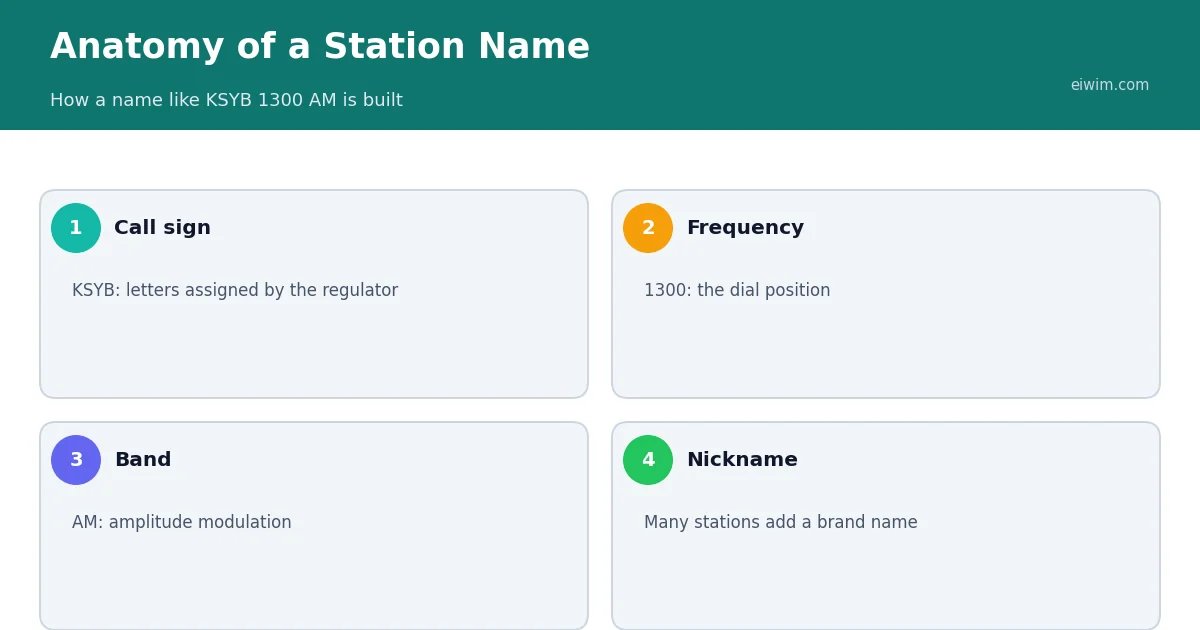
A call sign is the unique identifier assigned to a broadcast station by its national regulator. In the United States this is the Federal Communications Commission (FCC). Stations are required to announce their call sign at set times, and the letters appear on station pages, in listings and in radio dial guides.
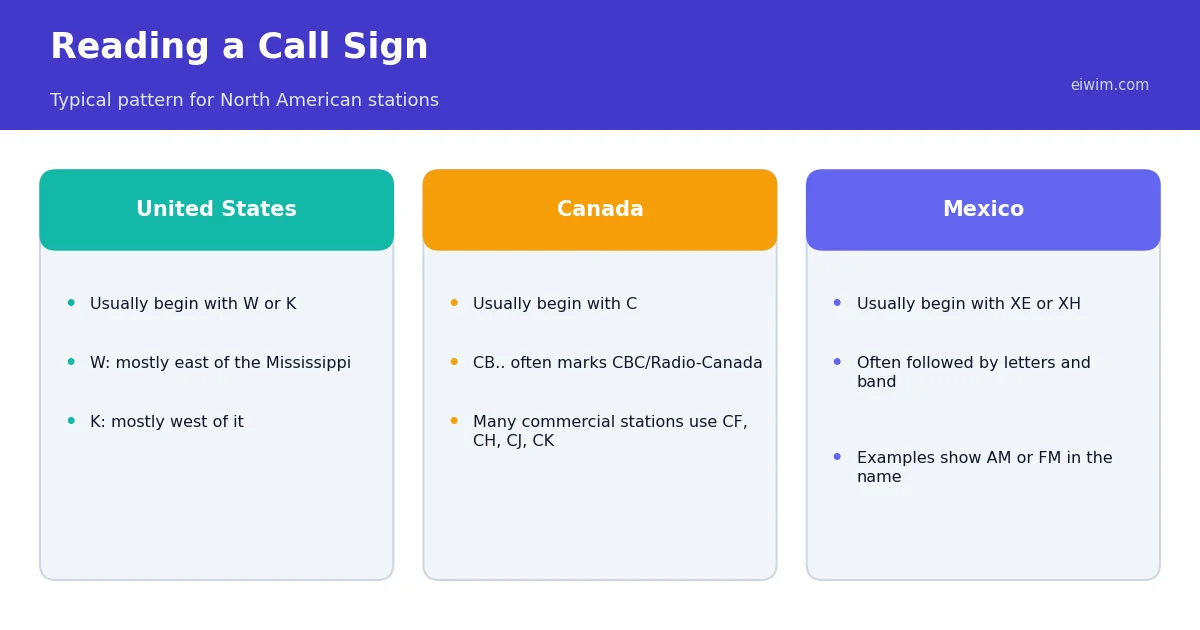
United States: W and K
US call signs typically have three or four letters. As a general rule, stations east of the Mississippi River begin with W (for example WNYC in New York) and stations to the west begin with K (for example KQED in San Francisco). There are historical exceptions: KDKA in Pittsburgh, one of the first commercial stations, kept its K, and WBAP in Fort Worth kept its W. Browse the USA page to see how many different combinations exist.
Canada: the C prefixes
Canadian call signs generally begin with C. Public broadcaster CBC and its French-language counterpart Radio-Canada use CB prefixes for many stations, while commercial stations often use CF, CH, CJ or CK. Explore the Canada listings to see them.
Mexico: XE and XH
Mexican stations use call signs beginning with XE or XH. AM stations have historically used XE and FM stations XH, although you may see both. See the Mexico page, and our guide to Mexican radio styles.
Why a number and band follow the letters
Because many stations share similar names, the frequency and band are added to tell them apart: "1300 AM" or "92.3 FM". Over time stations also adopt brand names, such as "The Boom" or "Alt 92.3". Some online directories list the call sign, the frequency and the brand together, so the same station can appear as "WZRH ALT 92.3 FM".
Other countries do not use call signs the same way
Many countries, especially in Europe, do not require call signs. Stations such as those in Germany, France or the United Kingdom are identified by name and frequency, and regulators license the transmitters rather than assigning letters. That is why stations in these places are usually listed only by their brand name.
Practical uses
- If you only know a station's call sign, search for it directly on a directory to find the stream.
- If you are moving or travelling, the first letter gives a rough idea of region.
- If you want to understand more radio vocabulary, see our beginner's glossary.
North American stations are also home to many genres. Try Country, News-Talk and Classic Rock to hear the variety.
Reading some real-world patterns
Once you know the basics, call signs become easy to read. A four-letter sign beginning with W, such as WABC or WXYZ, points to a US station east of the Mississippi in the traditional pattern, while one beginning with K, such as KABC or KXYZ, points to the west. Three-letter signs exist too, especially among older stations. In Canada, a sign such as CBC or CJXX tells you the country at once. Stations often add the frequency and a nickname, so you might see a name like "Hits 101.9" next to the official call sign. The call sign is the legal identifier, and the nickname is the brand.
Why call signs sometimes change
A station's call sign is not always permanent. When a station is sold, changes format or rebrands, the owner may request a new call sign. Sometimes letters are chosen to spell something memorable, such as initials or a word related to the station's format. Because of this, the same set of letters can appear on different stations at different times in history. If you are searching for a station you heard about years ago, remember that it may now have a different name or call sign.
Call signs for other services
Broadcast stations are not the only users of call signs. Amateur radio operators have personal call signs, assigned to individuals, that begin with prefixes specific to each country. Aircraft, ships and some government services also use identifying codes. The International Telecommunication Union allocates blocks of letters to each country, which is why the first letters of a sign reveal its origin. This system makes it possible to identify where a transmission comes from, even if you cannot understand the language.
Using call signs to search
If you know a station's call sign, you can search for it directly on a directory. Typing the letters is often faster than remembering a nickname. If you do not know the call sign, look at the station's name for clues, such as a frequency or a city. Our guide to listening to radio stations online explains how a station page works, and you can also narrow your search by browsing radio from the USA or radio from Canada.
A short exercise
Open the station list for the USA or Canada and look at ten names. For each one, try to guess whether it is a call sign, a nickname or a mixture of both, and note the first letter. This small exercise quickly teaches you to separate the identifying letters from the branding that surrounds them.
What call signs tell you about a station
Besides pointing to a country, a call sign can sometimes hint at the station's age or type. In the United States, three-letter signs tend to belong to some of the oldest stations, while four-letter signs became standard later. Letters at the end of a Canadian sign sometimes identify a region or a network. Suffixes or numbers on a frequency may show whether a station is a main transmitter or a repeater that extends coverage. None of this is essential for enjoying the radio, but it is a pleasant piece of detective work, and it helps you recognise how the broadcast system is organised. You can practise on any list of North American stations, for example radio from the USA.
Quick answers
Do all US stations start with W or K?
Almost all. A few historic exceptions exist, and the east-west rule is only a general guide.
Why do UK and German stations not use call signs?
Their regulators license transmitters and stations are known by brand name and frequency.
Can I search by call sign?
Yes. Entering the letters on a directory is often the quickest way to find a station.