Best Radio Genres for Studying and Focus (and What to Avoid)
October 28, 2026 · Updated November 01, 2026
Many people study or work with music on, and radio is a convenient source: no playlists to build and no decisions to make. Whether it actually helps depends on you, the task and the kind of music. There is no single rule, but some patterns are widely reported.
Why the type of music matters
Tasks that involve reading or writing use the same part of your attention as speech, so songs with lyrics can compete with them. Many people therefore find instrumental music or sounds without words easier to work with. Others concentrate better with familiar songs. Treat the suggestions below as starting points and notice what works for you.
Genres to try
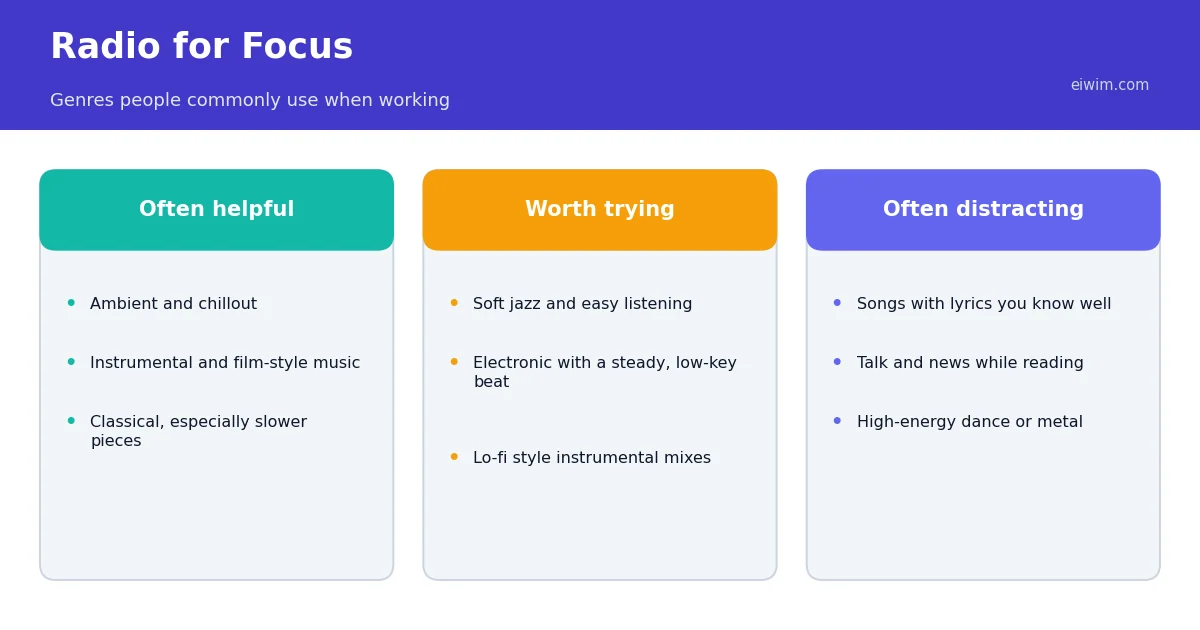
- Ambient: slow, textural and mostly beatless. Browse the Ambient stations if you want sound that stays in the background.
- Chillout: relaxed electronic music with a gentle pulse. See Chillout.
- Instrumental: music without lead vocals, from acoustic guitar to cinematic pieces. Try Instrumental.
- Classical: slower orchestral and solo works are a long-standing study choice. Start with Classical and see our classical radio guide.
- Jazz and easy listening: calm, melodic and unobtrusive. Look at Jazz and Easy Listening.
What to avoid when you need to concentrate
- Talk and news: speech competes with your own thoughts, especially while reading or writing.
- Songs you love: you may find yourself singing along or listening instead of working.
- Very fast or loud music: high-energy genres can raise intensity and make focus harder for some people.
Tips for better focus sessions
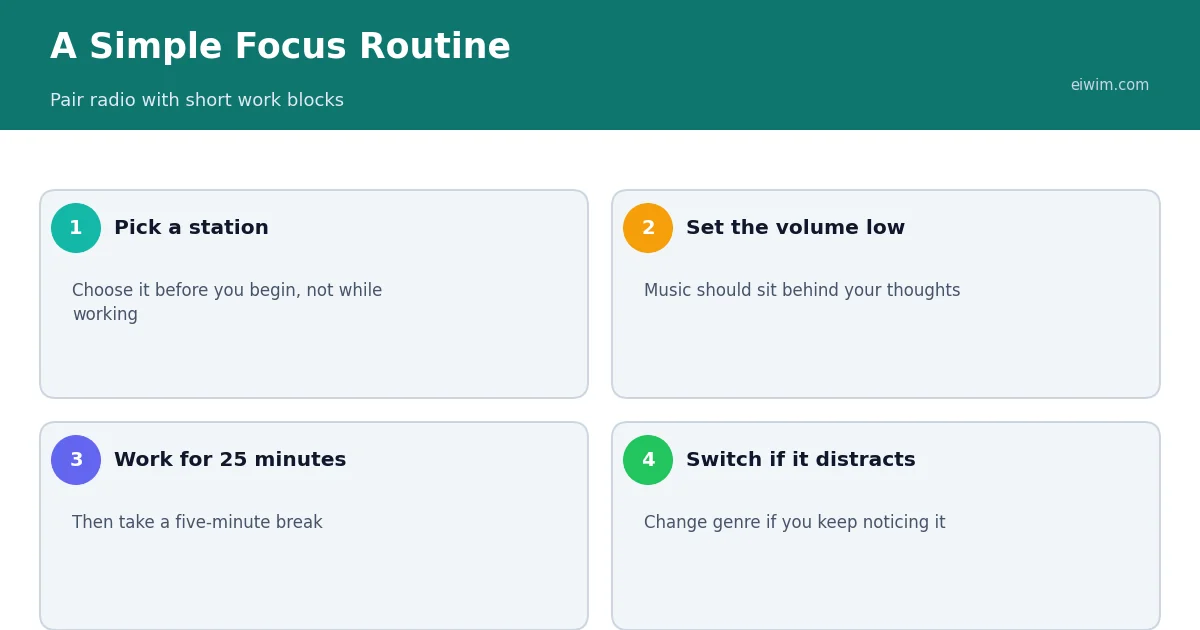
- Choose a station before you start, so you are not hunting for something mid-task.
- Keep the volume low enough that you could comfortably hold a conversation over it.
- Use short work blocks, for example 25 minutes of work followed by a five-minute break.
- If you notice the music more than the task, switch to a quieter genre or turn it off.
- Match the music to the task: calmer sounds for reading and writing, and perhaps something more upbeat for repetitive jobs such as tidying or filing.
Streaming considerations
Radio streams are free and run all day, but a stream that drops out will break your concentration. Use a stable connection and, if your internet is weak, pick a lower-bitrate station. Our guide to stream problems can help if audio cuts out.
Not sure where to begin? Open the genres page, try three stations from the genres above, and note which one you forget about while working. That is usually the one that suits you.
Different tasks, different music
The best background music depends on what you are doing. For maths, coding and other analytical work, steady music without lyrics, such as Ambient, Instrumental or Classical, is a popular choice. For writing and reading, quiet music is usually best, and many people prefer silence or very soft instrumentals, because words in a song can compete with the words on the page. For creative work, such as design, drawing or brainstorming, you can often use something more lively and varied, for example Jazz or Chillout. For repetitive tasks such as sorting files, a favourite Pop or Rock station may help the time pass. If you notice that you keep losing your place, try a calmer genre.
Tempo and volume
Two practical settings matter as much as genre. Tempo affects how alert you feel. Slow, steady music tends to relax you, while faster, more energetic music can raise your pace, which is good for exercise but not always for careful reading. Volume matters too. If the music is loud enough to draw your attention, it is too loud. Aim for a level that you could ignore if you wanted to, and make sure that your device or speakers are not set at maximum. Our guide to speakers and headphones for radio has tips on comfortable listening.
Build a focus session
A structured session can make background music more effective. Many people use the Pomodoro technique, in which you work for 25 minutes and then take a five-minute break, repeating the cycle several times. You can pair this with radio by choosing a calm station for the work blocks and something livelier for the breaks. During the break, stand up, stretch and let your mind rest. After four cycles, take a longer break. The key is to decide the plan before you start, so you spend your energy on the work, not on picking a station.
When silence is better
Music is not for everyone or every task. If you are learning something completely new, solving a difficult problem or proofreading, silence or very light noise may help you concentrate. If you share a space, headphones can protect your focus and avoid disturbing others. Some people prefer a steady background sound such as rain or white noise to music, and many online stations offer these. Try working with music for a week, then without it for a week, and notice when you get more done. Your own results matter more than general advice.
Working in shared spaces
If you study in a library, office or shared home, use headphones, keep the volume low and choose a stream that will not stop unexpectedly. A stable stream is important, so choose stations with reliable streams and check our guide to fixing streams that will not play in case there is a problem. If you are on mobile data, a lower bitrate saves your allowance, as explained in our guide to bitrate and stream quality.
Genres to try for specific moods
If you are tired and need a gentle lift, try Easy Listening or soft Pop. If you feel anxious or overloaded, slow Ambient or Classical may help you settle. If you need to stay awake during a long task, upbeat instrumental Electro or Chillout with a steady rhythm can keep your energy level even. If you are revising for exams, choose one station and keep it constant so that the sound becomes part of your routine, which can make it easier to get into study mode each time you press play. As always, notice what works for you and adjust.
Quick answers
Is it better to study in silence?
It depends on you and the task. Some people concentrate best in silence, while others prefer quiet background music.
Why are lyrics distracting?
Words compete with the language you are reading or writing, so many people prefer instrumental music for those tasks.
Should I use talk radio while working?
Usually only for tasks that do not need reading or writing, such as tidying or simple data entry.